
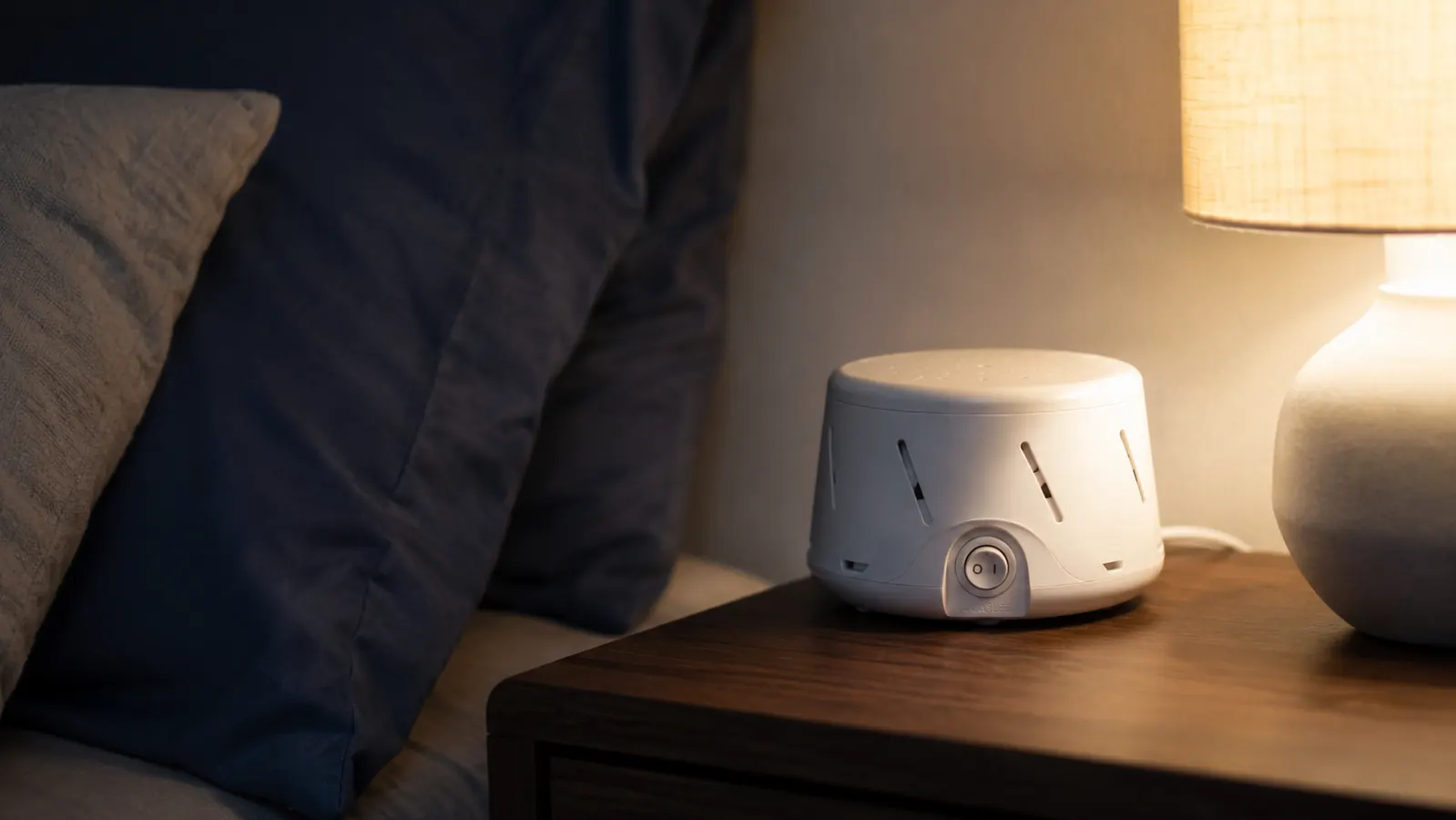
Last November I was waking up four or five times a night. Not because of anything medical, just a combination of my husband's breathing, the garbage truck at 5:15 a.m., and whatever branch kept scraping the side of our house. I had tried earplugs, a fan, a free app on my phone. Nothing stuck. My daughter, who works in pediatric audiology, finally said something that made sense: stop masking the noise and start covering it with something consistent. She pointed me to the Yogasleep Dohm Classic. Six months later the Dohm is still on my nightstand. This review covers what actually changed, what I wish was different, and who I think should buy one.
The Dohm Classic is not new technology. Yogasleep introduced it in 1962, and the basic design has barely changed: a small electric motor spins a fan inside a plastic housing, and you tune the sound by rotating two plastic caps. No Bluetooth, no app, no digital recordings. Just a steady mechanical hum that a lot of people find easier to fall asleep to than anything a smartphone can produce. Whether that is true for you is the whole question this review tries to answer.
The Quick Verdict
The Dohm Classic earns its reputation after six months of nightly use. The real-fan sound is noticeably softer on the ears than any digital recording I have tried, and the two-cap tuning system gives just enough control without any complexity. The one real limit is volume: it does not get loud enough to cover a snoring partner at full volume. For everything else, including traffic, early alarms, and the 5 a.m. garbage truck, it works.
Amazon Check Today's Price →Still waking up to every creak and truck? The Dohm has been covering bedroom noise since 1962.
The Yogasleep Dohm Classic uses a real spinning fan, not a looping digital recording, so the sound never repeats. Over 40,000 Amazon buyers rate it 4.6 out of 5.
Amazon Check Today's Price on Amazon →How I Have Used It
I run the Dohm every single night, from when I get into bed around 10 p.m. until my alarm goes off at 6:30 a.m. That is roughly 8.5 hours per night over six months, which puts me somewhere around 1,500 hours of use. I have also brought it on two trips, once to a hotel downtown and once to visit my sister, whose guest room faces a busy street. Beyond that, I set it up temporarily in my home office during a stretch of road construction that made focusing nearly impossible.
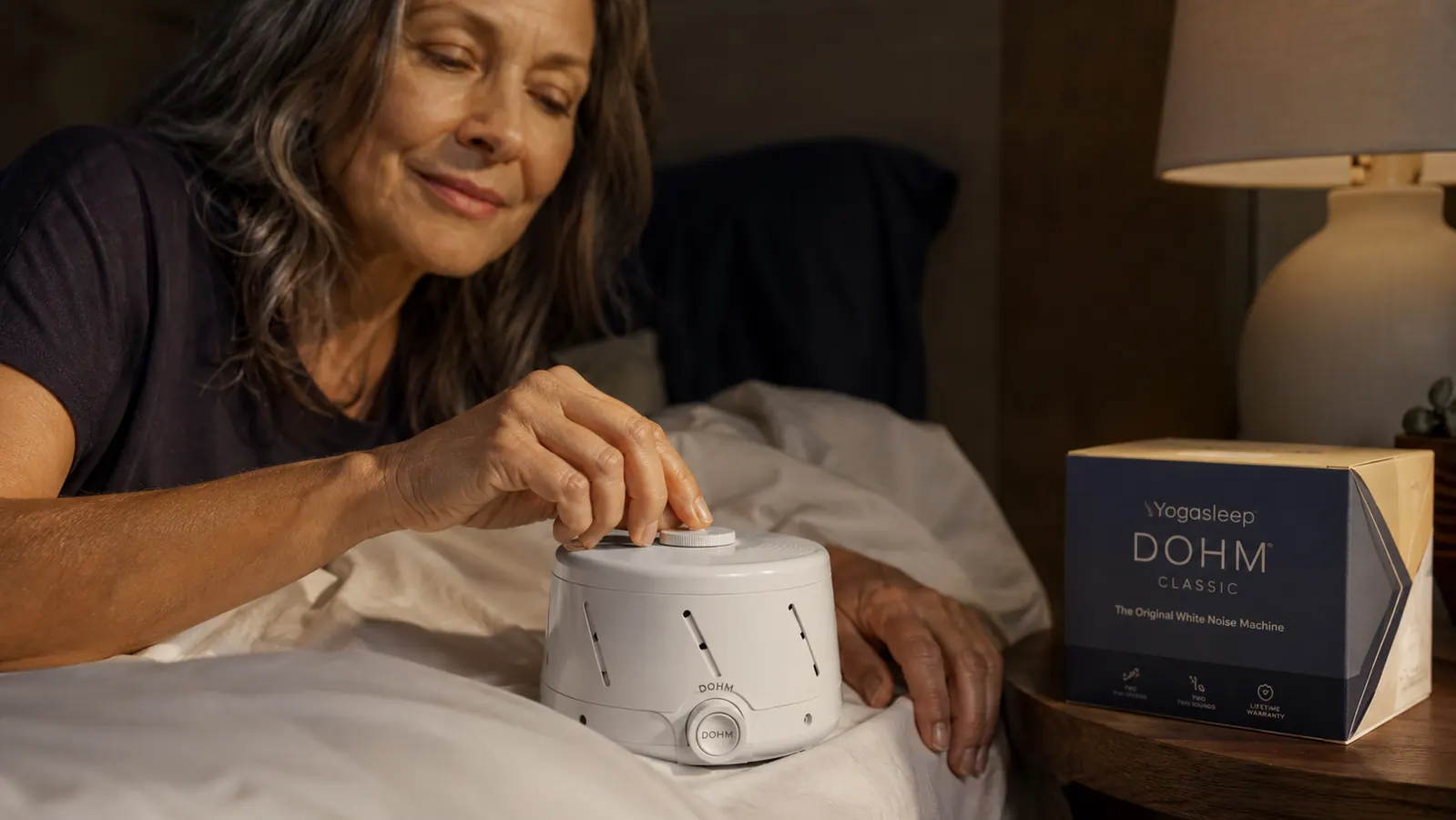
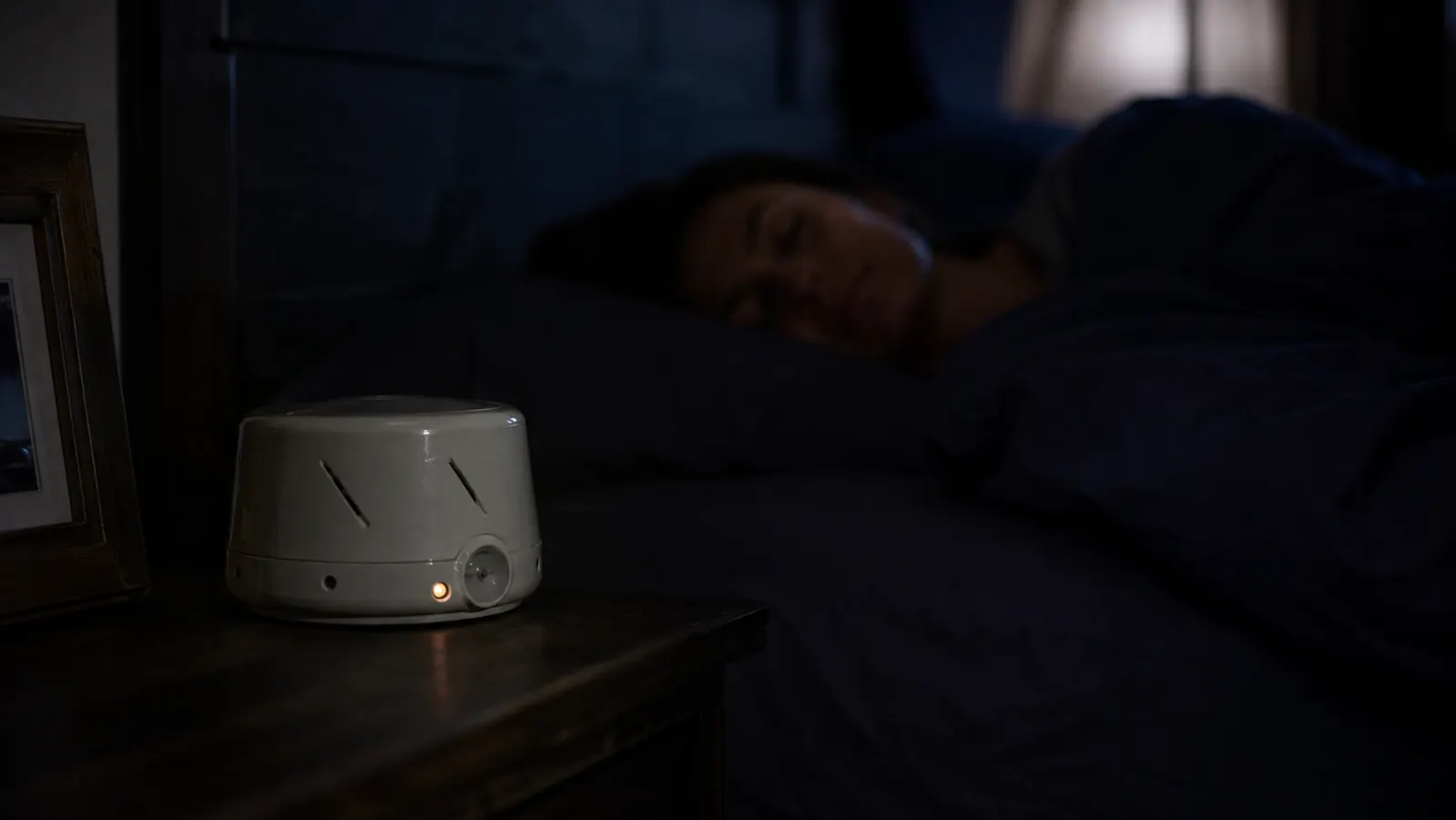
My bedroom setup: the Dohm sits about three feet from my head on the nightstand, at roughly ear height when I am lying on my side. I have the tone cap rotated to the midpoint and the volume cap open about two-thirds of the way. That setting produces what I would describe as a low, full-bodied rushing sound, similar to a very steady breeze through a slightly open car window. It took me about four nights to stop noticing it consciously. By the second week, I stopped waking to outside noise almost entirely.
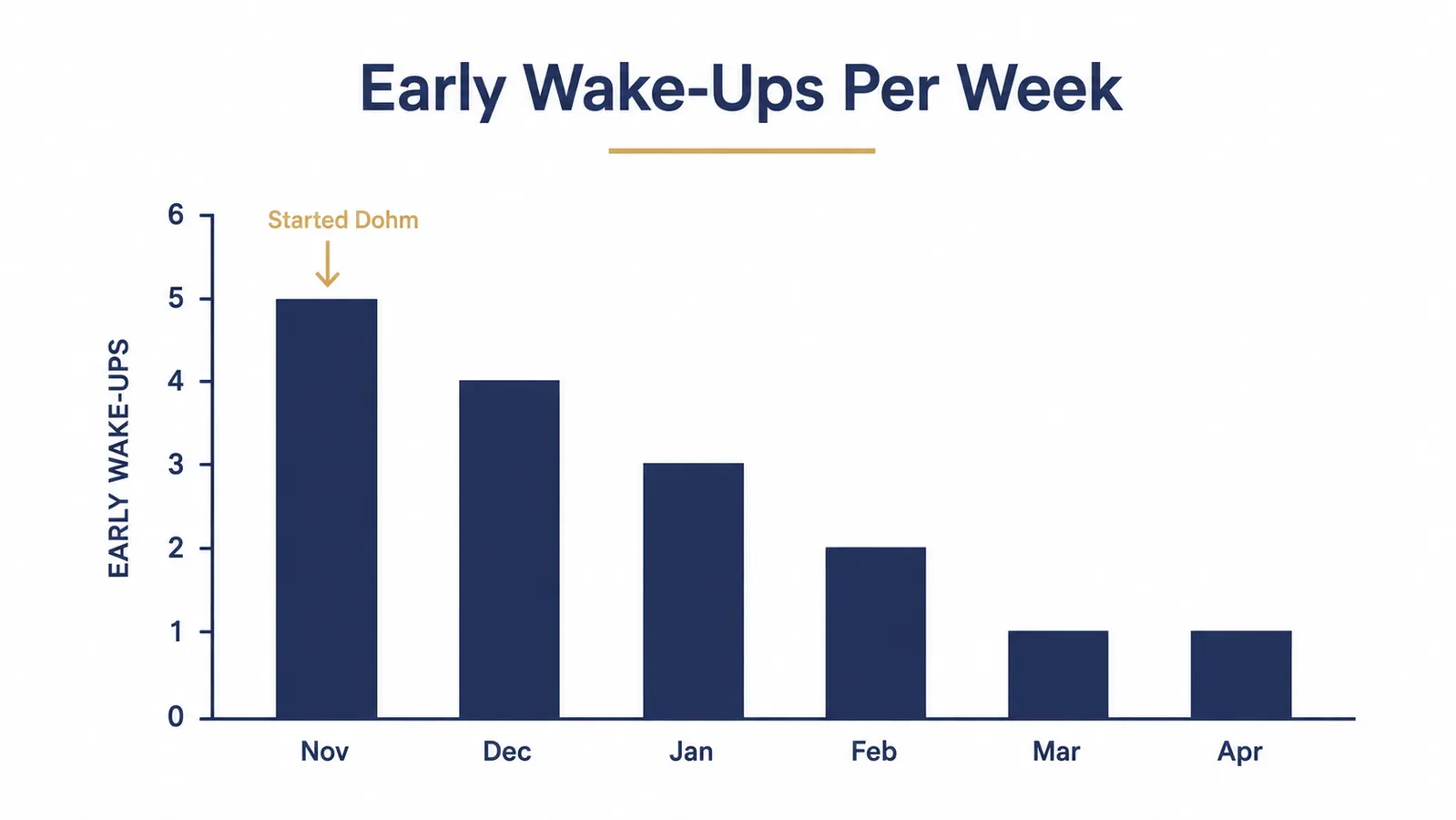
I tracked wake-ups loosely using a notebook on the nightstand, just tallying marks any time I woke up fully before the alarm. In October, the month before the Dohm, I averaged 4.2 full wake-ups per night. By December that was down to 1.1. By February it was under one, and I attribute most of those remaining interruptions to my husband getting up for water rather than external noise.
What Makes the Sound Different From a Digital Machine
This is the piece I want to spend real time on because it is the thing most reviewers gloss over. Digital white noise machines, and phone apps, play recorded or synthesized audio on a loop. Even when the loop is long, your brain eventually patterns to it. The repeating structure becomes background, yes, but it is never quite seamless, and some people, including me, can sense the cycling even if they cannot consciously identify it.
The Dohm's sound is not a recording. The motor and fan produce sound continuously and slightly differently each second, the way a real fan or a running stream does. There is no loop, no reset, no subtle rhythm. The variation is small but it is genuine. I noticed the difference immediately when I tried a digital machine at my sister's house mid-December. It sounded cleaner in some ways, more controllable, but after two nights I was back to preferring the Dohm's texture. It is harder to describe than to experience.
A digital machine loops. The Dohm just runs. After six months of both, I can tell you that difference matters more than I expected.
The frequency range matters too. The Dohm leans toward lower mid-frequencies, a softer, broader sound compared to the bright hiss of many digital machines. That lower register is easier on my ears over eight hours. By contrast, a sharp high-frequency white noise loop can feel a little fatiguing when I wake up and notice it. The Dohm never bothers me that way.
The Two-Cap Tuning System: Useful or Gimmicky?
The Dohm has two adjustable plastic caps. The outer cap controls overall volume by narrowing or opening the vents on the housing. The inner cap (the tone cap on top) rotates to change the pitch and character of the sound. Between the two, you have a modest but genuinely useful range of adjustment.
I set mine once in the first week and have touched it maybe twice since. That is both a compliment and a limitation. The compliment: once you find your setting, it holds perfectly. The limitation: the range is not wide. If you want to go from very quiet background murmur to something that genuinely competes with loud snoring, you may not be able to get there. The loudest setting is not as loud as a box fan on medium. For covering a moderate snorer or blocking intermittent street noise it works well. For a loud snorer sharing a wall, I would want something with a wider volume range.
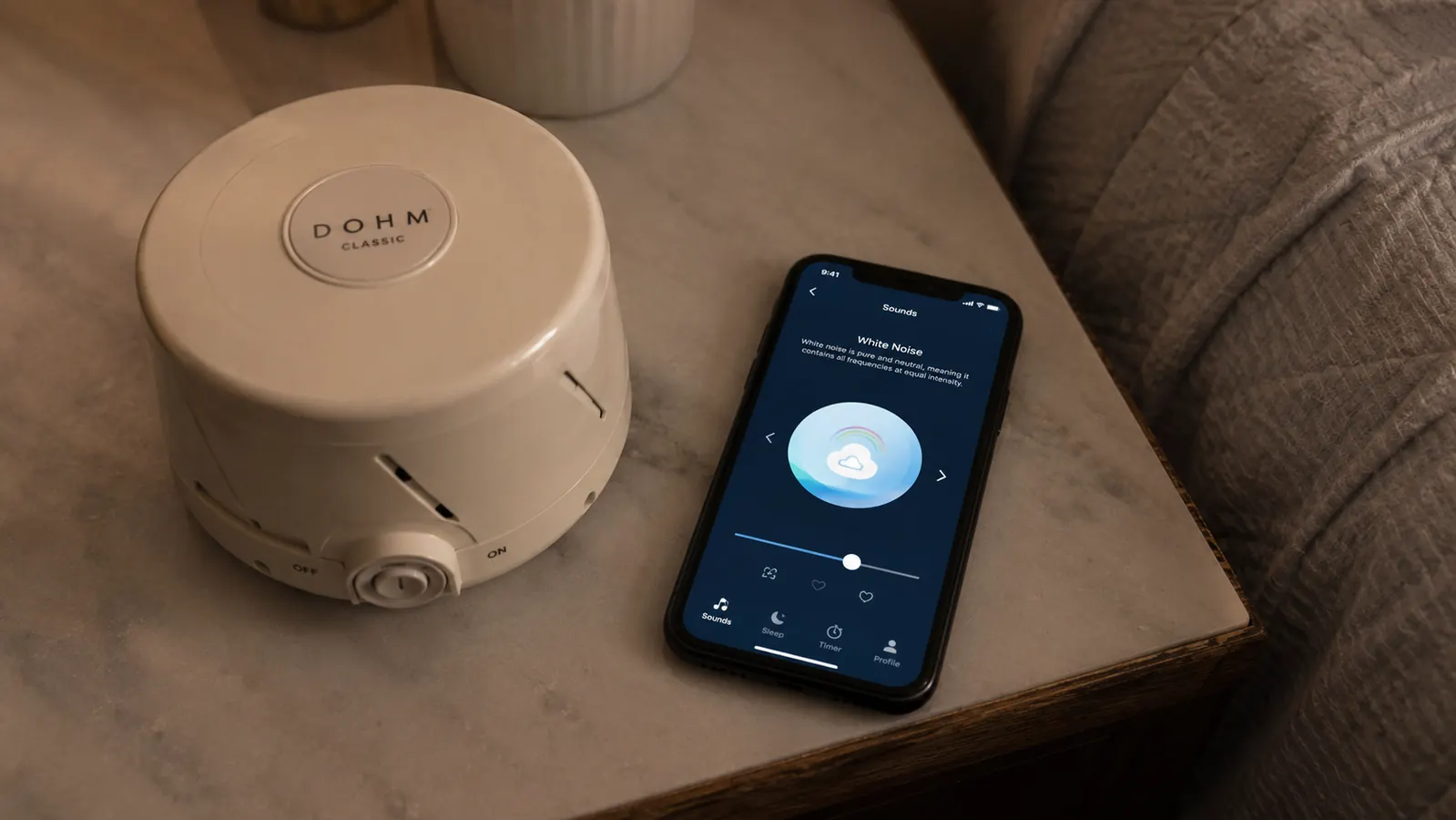
The physical controls also mean there is no timer, no fade, no alarm integration. You plug it in and turn it on; you unplug it or press the switch when you want it off. For some people, that simplicity is a feature. I am in that group. My phone stays across the room, and I do not want a machine with an app that tempts me back to a screen. But if you want to schedule quiet hours or pair with a smart speaker, the Dohm cannot help you.
Build Quality Over Six Months
The housing is hard plastic with a matte finish that has not scratched, cracked, or discolored in six months of daily use and two moves. The power cord is about five feet, which reaches my outlet without an extension. The motor runs warm to the touch but not hot, and after 1,500-plus hours I have not noticed any change in sound quality or smell.
The one mechanical concern: the tone cap developed a very faint rattle sometime around month four. It does not affect the sound in a meaningful way, just a small vibration I can feel if I put a fingertip on the cap. I tightened it gently and the rattle went away for about a month, then came back at the same low level. It is not something I would return the machine over, but it is worth knowing. A few Amazon reviews mention the same thing developing between three and six months in.
The machine is also remarkably small: about 5.5 inches in diameter and just under 4 inches tall. It fits easily on a crowded nightstand without taking up meaningful space, and the cord tucks along the back cleanly. I have seen larger machines with more features that I ended up pushing aside because they were awkward. The Dohm stays.
Travel Performance
I brought the Dohm downtown to a hotel room on the 12th floor facing a busy intersection. The room had the kind of HVAC that cycles on loudly and then goes silent, which always wakes me up. With the Dohm running, the HVAC cycling was masked well enough that I slept through four on-off cycles that I would normally notice. I woke up feeling rested in a way I almost never do in hotels.
The main travel inconvenience is the cord. The Dohm does not run on batteries, so you need an outlet within cord reach of wherever you are sleeping. In my sister's guest room that was not a problem. In the hotel, it required a small extension cord I now keep in my travel bag. It is also slightly too big to fit in a standard toiletry bag, so I pack it in a small drawstring pouch. Manageable, but worth knowing if you travel light.
What I Liked
- Real mechanical fan sound with no loop, no digital artifacts, no repeating pattern
- Lower-frequency tone that is easy on ears over a full night
- Simple two-cap tuning that stays put once set
- Compact footprint on a nightstand
- Very consistent performance after 1,500-plus hours of use
- No app, no Bluetooth, no setup complexity
Where It Falls Short
- Maximum volume is not loud enough to cover a heavy snorer
- No timer, sleep timer, or smart-home integration
- Tone cap developed a minor rattle around month four
- Requires a wall outlet and cord reach, no battery option
- Only one sound profile (mechanical fan); no nature sounds or other options
How It Compares to What I Tried Before
Before the Dohm I used three things. A box fan on the floor, which worked reasonably well but moved too much air in winter and picked up dust in a way that affected my allergies by March. A free white noise app on my phone, which kept my phone in the bedroom, which meant I was tempted to check it, and the looping quality bothered me once I noticed it. And foam earplugs, which compressed sound reasonably well but made my ears sore after a few hours and always fell out.
The Dohm replaced all three. It does not move air so there is no cold-air problem and no dust issue. It does not require my phone to be in the room. And I can sleep on either side without pulling anything out of my ear. The comparison article on this site goes deeper on the Dohm versus the LectroFan, which is the digital alternative most people compare it to. See that piece if you want side-by-side specifics. For my purposes, the Dohm replaced three separate workarounds with one plug-in device.
The one thing earplugs do that the Dohm cannot is actually attenuate sound. The Dohm masks noise by covering it with something steadier, it does not physically block anything. If the noise source is very loud, like a construction site directly outside the window, masking alone may not be enough. In that case, earplugs plus the Dohm together would work better than either alone. I tried that combination during the road construction stretch and it was very effective.
Who This Is For
The Dohm Classic is the right machine if you are bothered by intermittent noises, traffic, early-morning sounds, a partner who gets up early, or light sleeper sensitivity to the general ambient noise of a house. It is also a strong choice if you have tried digital machines and found the sound a little thin or artificial. The real-fan tone is meaningfully different and worth experiencing if you are on the fence. Finally, it is a good fit if you want something simple with no screen, no setup, and no ongoing decisions.
Who Should Skip It
If your primary problem is a loud snoring partner, the Dohm may not get loud enough at its maximum setting. You would need a machine with more volume range or a combination approach with earplugs. If you want nature sounds, rain, ocean, or anything beyond fan noise, the Dohm has none of that. And if you want smart-home integration, a sleep timer, or an app, you will be frustrated. The LectroFan or a similar digital machine would serve those needs better. This is a machine that does one thing very well and nothing else, and that trade-off is exactly right for some people and exactly wrong for others.
One more group to mention: if you are a hot sleeper looking for a machine that also moves air, a real fan is probably the better call. The Dohm produces the sound of a fan without the airflow, which is an advantage in winter and neutral in summer but not a cooling solution. I run a separate ceiling fan in July and keep the Dohm for sound only.
Ready to stop waking up to every sound in the house? The Dohm runs quietly all night and never loops.
The Yogasleep Dohm Classic is available on Amazon with free shipping on eligible orders. Over 40,000 buyers, rated 4.6 out of 5 stars. If it does not work for you, Amazon's return window gives you time to find out.
Amazon Check Today's Price on Amazon →